





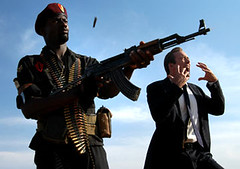
LIBERIA, Africa - I didn't travel to Liberia to write this story (the dateline is a little misleading), but the movie has plenty of scenes from there and elsewhere in Africa, scenes that will make you wonder about guns, armies, and what role the U.S. plays in, well, guns and armies in other countries.
I am definitely not a fan of Nicolas Cage, but in this film he pulls off a very difficult acting job with a real aplomb.
Without putting too fine a point on it, don't read any reviews of this movie, just go and be surprised because it is not the movie I thought I was going to see - it was 10 times better.
It's not in the same class as Million Dollar Baby, but worth shelling out the money to see it on the big screen.
The foray to see Lord of War was the first time I had been in a Sacramento movie theater in some time. And I had sticker shock: $19 for the two of us for a 5 p.m. viewing
Nineteen dollars! And there was no shortage of people trying to crowd into the multiplex where we went.
I guess Nicolas Cage has to eat, too.
But $19? Jaysus.
Sunday, September 25, 2005


Thursday, September 22, 2005
Rolling Stone's story about the HST cannon
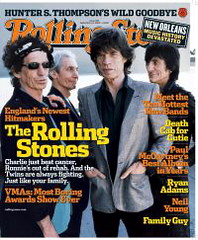
WOODY CREEK, Colo. - The Sept. 22 issue of Rolling Stone, which has The Rolling Stones themselves on the cover, has a great piece in it about the Hunter S. Thompson memorial service in which his ashes were shot out of a cannon that was taller than the Statue of Liberty.
And in part of the article, HST's mostly likely last written words were printed, written on Feb. 16, scrawled with a black marker and titled Football Season Is Over.
At the bottom of the page, Hunter drew a happy heart, the kind found on Valentine's Day cards. Four days later he committed suicide by firing his pistol into his mouth.
Suicide is hard to understand in general and in specific I've written more than a few angry words about HST's death. But the note says a lot if you read it carefully. It could be written by any one of hundreds of thousands - maybe millions - of older people who find themselves suddenly incontinent and confused or just tired of struggling with failing bodies and failing brains in a world that seems to be kind of failing itself.
But as a piece of writing, the article by Douglas Brinkley is well worth a look.
I wish I had written the article but even more to have been there to witness blast and the blizzard of ashes.
And in part of the article, HST's mostly likely last written words were printed, written on Feb. 16, scrawled with a black marker and titled Football Season Is Over.
No More Games. No More Bombs. No More Walking. No More Fun. No More Swimming. 67. That is 17 years past 50. 17 more that I needed or wanted. Boring. I am always bitchy. No Fun - for anybody. 67. You are getting Greedy. Act your old age. Relax - This won't hurt.
At the bottom of the page, Hunter drew a happy heart, the kind found on Valentine's Day cards. Four days later he committed suicide by firing his pistol into his mouth.
Suicide is hard to understand in general and in specific I've written more than a few angry words about HST's death. But the note says a lot if you read it carefully. It could be written by any one of hundreds of thousands - maybe millions - of older people who find themselves suddenly incontinent and confused or just tired of struggling with failing bodies and failing brains in a world that seems to be kind of failing itself.
But as a piece of writing, the article by Douglas Brinkley is well worth a look.
I wish I had written the article but even more to have been there to witness blast and the blizzard of ashes.
Saturday, September 17, 2005
Star Trek 'Insurrection' and slowing time down
SACRAMENTO, Calif. - The last two weeks, or maybe three, have gone by in such a blur of classes, writing assignments, meetings - and all the sundry details of life like cooking and laundry and cleaning - that I was shocked yesterday to see it was Sept. 16. Where did the summer go?
Today, a Saturday, used to be my refuge from such a speedy life, but now seems like the day of the week I use to catch up with the all of those things I need to do, things that race ahead of me like the Roadrunner, just out of reach.
But last night I took the evening off to watch a favorite movie from the Star Trek movie series, one in which the crew of the Enterprise saves the people on a planet where age is meaningly because metaphasic radiation regenerates DNA and people never grow old. They have all the time they want to do whatever they want because they know tomorrow never really comes.
As I sit here with both knees aching, my wrists sore from typing and a slight backache starting to climb up my leg (damn that sciatic nerve), a visit with the Baku people might seem in order, for, say, a couple of hundred years.
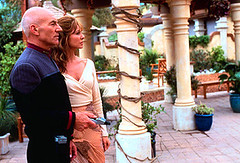
The reason I like this particular Star Trek so much is a scene in which the lead actress (played by the lovely and talented Donna Murphy) teaches Captain Picard how to slow time down to enjoy a moment. In the movie, of course, a hummingbird nearby literally flies in slo-motion and the waterfall nearly stops.
But the other reason I like the movie is that it reminds me that you don't have to be taught by Donna Murphy how to do this (though I am in need of a tutor if she's not shooting a film). You need to slow yourself down and enjoy the moment.
As my son Dustin has taken to say recently: 'Breathe, Breathe.'
Kayaking on the American River right behind the house has had that kind of effect, in which suddenly coming up on a flock of geese ghosting across the water or drifting up on a log covered with snapping turtles is almost magical. Better yet might be to simply sit on the riverbank and watch the water flow by.
If I get a chance to sit by the river today - no make that when I go to the river today - I'm going to focus on the water and see if I can't slow time down as Ms. Murphy taught Jean-Luc.
All the school work, writing, getting ready for next week's meetings and other sundry matters will still be waiting for me back at the house.
The trick will be to enjoy that moment and forget the paragraph above this one.
Today, a Saturday, used to be my refuge from such a speedy life, but now seems like the day of the week I use to catch up with the all of those things I need to do, things that race ahead of me like the Roadrunner, just out of reach.
But last night I took the evening off to watch a favorite movie from the Star Trek movie series, one in which the crew of the Enterprise saves the people on a planet where age is meaningly because metaphasic radiation regenerates DNA and people never grow old. They have all the time they want to do whatever they want because they know tomorrow never really comes.
As I sit here with both knees aching, my wrists sore from typing and a slight backache starting to climb up my leg (damn that sciatic nerve), a visit with the Baku people might seem in order, for, say, a couple of hundred years.
The reason I like this particular Star Trek so much is a scene in which the lead actress (played by the lovely and talented Donna Murphy) teaches Captain Picard how to slow time down to enjoy a moment. In the movie, of course, a hummingbird nearby literally flies in slo-motion and the waterfall nearly stops.
But the other reason I like the movie is that it reminds me that you don't have to be taught by Donna Murphy how to do this (though I am in need of a tutor if she's not shooting a film). You need to slow yourself down and enjoy the moment.
As my son Dustin has taken to say recently: 'Breathe, Breathe.'
Kayaking on the American River right behind the house has had that kind of effect, in which suddenly coming up on a flock of geese ghosting across the water or drifting up on a log covered with snapping turtles is almost magical. Better yet might be to simply sit on the riverbank and watch the water flow by.
If I get a chance to sit by the river today - no make that when I go to the river today - I'm going to focus on the water and see if I can't slow time down as Ms. Murphy taught Jean-Luc.
All the school work, writing, getting ready for next week's meetings and other sundry matters will still be waiting for me back at the house.
The trick will be to enjoy that moment and forget the paragraph above this one.
Tuesday, September 13, 2005
A book that makes sense of the new world
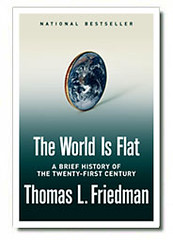
SACRAMENTO, Calif. - Thomas Friedman's The World is Flat ranks right there with The Population Bomb (Paul Ehrlich), The Search for Excellence (Tom Peters) and maybe The Reckoning (David Halberstam) as books that have, for me, hit the proverbial nail on the head. (Please excuse the cliche, but it fits...)
And it's not because I agree with the politics - it's the sharp analysis. The World is Flat makes sense of a world that is so different from say, 20 years ago, maybe even 10 years ago.
When you call up an airline to make a reservation (provided you don't go online to make your own reservations) the person you are likely talking with is in Bangalore, India, or maybe Panama. When you give your income tax to your local accountant, he or she, in turn, isn't spending weekends laboring over your Schedule B deductions - someone on the other side of globe is, your income tax data having been digitized and zapped through cyberspace. And don't even think about those people answering phones in the Ukraine with your queries about the problems with your credit card.
Oh my God, Americans are losing jobs?
Well, that's the thing about this book. While some jobs are being lost, others are being gained in a shift that is fairly quickly making the nation-state as we know it irrelevant.
Friedman traces in one chapter how his Dell Computer was manufactured - where the parts came from, who assembled it, how more computers come on line.
Would you be surprised to know that Dell Computers - a player in the computer industry but not the biggest - sells 150,000 computers a day? A day! And the system of sales and manufacturing is so sophisticated that if you call this moment and order a unit, all over the world adjustments are made to ensure that when the person calls after you, all the compenents are available for their computer - and the next 149,998 people, too.
In education, we face the biggest challenges because as education leaders have warned for years, much of the rest of the world is way ahead of us in providing solid education - from kindergarten through PhDs.
Perhaps the most telling quote is an African proverb, translated into Mandarin, posted on the factory floor of an American auto parts manufacturer - at its factory in China.
I've read it to my students and asked them to think about it, hard.
And it's not because I agree with the politics - it's the sharp analysis. The World is Flat makes sense of a world that is so different from say, 20 years ago, maybe even 10 years ago.
When you call up an airline to make a reservation (provided you don't go online to make your own reservations) the person you are likely talking with is in Bangalore, India, or maybe Panama. When you give your income tax to your local accountant, he or she, in turn, isn't spending weekends laboring over your Schedule B deductions - someone on the other side of globe is, your income tax data having been digitized and zapped through cyberspace. And don't even think about those people answering phones in the Ukraine with your queries about the problems with your credit card.
Oh my God, Americans are losing jobs?
Well, that's the thing about this book. While some jobs are being lost, others are being gained in a shift that is fairly quickly making the nation-state as we know it irrelevant.
Friedman traces in one chapter how his Dell Computer was manufactured - where the parts came from, who assembled it, how more computers come on line.
Would you be surprised to know that Dell Computers - a player in the computer industry but not the biggest - sells 150,000 computers a day? A day! And the system of sales and manufacturing is so sophisticated that if you call this moment and order a unit, all over the world adjustments are made to ensure that when the person calls after you, all the compenents are available for their computer - and the next 149,998 people, too.
In education, we face the biggest challenges because as education leaders have warned for years, much of the rest of the world is way ahead of us in providing solid education - from kindergarten through PhDs.
Perhaps the most telling quote is an African proverb, translated into Mandarin, posted on the factory floor of an American auto parts manufacturer - at its factory in China.
I've read it to my students and asked them to think about it, hard.
Every morning in Africa, a gazelle wakes up.
It knows it must run faster than the fastest lion or it will be killed.
Every morning a lion wakes up.
It knows it must outrun the slowest gazelle or it will starve to death.
It doesn't matter whether you are a lion or a gazelle.
When the sun comes up, you better start running.
It knows it must run faster than the fastest lion or it will be killed.
Every morning a lion wakes up.
It knows it must outrun the slowest gazelle or it will starve to death.
It doesn't matter whether you are a lion or a gazelle.
When the sun comes up, you better start running.
Subscribe to:
Posts (Atom)