Sunday, October 13, 2024

Steamboats, Seneca Lake, and the Haudenosaunee


A BOATHOUSE ON SENECA LAKE - Longtime Finger Lakes resident David Beardslee Schwartz has penned a clever collection of Seneca Lake-region tales from his view at his Lodi boathouse that will bring back memories and trigger a torrent of emotional remembrances in his newly released book, Waiting For The Steamboat at Lamoreaux Landing.

The memories and emotions certainly were there for me when I read his 19 entries beginning with a heart-wrenching tale about the first patient at the Willard Asylum titled Woman in the Crate. His finale, Waiting on the Steamboat,  engages the reader in a bit of time travel (as he does in other chapters) and ends a memorable book-long stroll down memory lane.

A bit of self-disclosure: David Beardslee Schwartz is my brother-in-law and although he has published other books, this very personal work is the book I have been waiting for him to write for decades. Sitting in the very boathouse to which he refers often in Waiting For The Steamboat, he has spun some of these stories as he and I chatted. He is a practiced story teller and it's great for me to see him publishing them in this volume for a wide audience. 

The ability to communicate in writing and music stretches across the Beardslee generations to whom this book is dedicated. Waiting For The Steamboat is introduced with a poem by Brett Beardslee, David's nephew known locally as Poet Laureate of Hector and for his musical performances around the Finger Lakes. The sentiments in Brett's poem, entitled The Old Outboard, will be familiar to anyone who has ever unsuccessful tinkered with an outboard motor with a carburetor. David writes wistfully himself about a 1958 outboard in the third chapter in which he skillfully describes the engine's aging - just like himself.

In addition to many personal memories linked to Seneca Lake and the region, David writes at length and with empathy about the Native American Haudenosaunee people, upon whose land virtually all people around Seneca Lake are living.

Across all 19 chapters, the author skillfully mixes his personal stories with current life in the Fingers Lakes. There's the sense of the slow-creeping shadow of age in Waiting For The Steamboat as time passedBut it's not wholly negative. David's writing offers more echoes of acceptance and contentment of a life well-lived.

The book will be officially released Monday, Oct. 21 at Rasta Ranch Winery on Route 414 in Hector from 5 to 8 p.m. to which the public is invited. During Monday Night Blues with Brett Beardslee, David will read from his new book and play some blues with his cousin.

Michael J. Fitzgerald Oct. 13 2024


Saturday, February 26, 2022

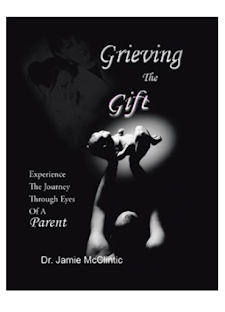
"Grieving The Gift" - a gift for parents and readers


   Grieving The Gift: Experience The Journey Through Eyes of A Parent by Dr. Jamie McClintic is an extraordinary book on many levels. It defies any attempt to pigeonhole it.

     On one level, it's an expertly told tale of the struggles the author faced when she gave birth to her daughter Maddox who has Down Syndrome. The book also chronicles the emotional rollercoaster that followed the birth. But even that attempt to summarize is feeble. It neglects to salute a remarkable personal narrative produced by McClintic and a book filled with pages of helpful clinical information and advice that other parents dealing with impacts of having a disabled child might face.

     A little reviewer self-disclosure is required. McClintic's father, journalist Greg Awtry, is a good friend, though I have never met Dr. Jamie McClintic in person. Nor have I met her daughter Maddox, whose birth and first decade of life fill this book. That said, after reading Grieving The Gift closely, I feel like I'm part of the family.  

     Grieving The Gift is not easy reading. The author is painfully honest and frank about her thoughts, reactions and struggles from the moment of Maddox's birth through the astounding challenges of her early years. Today Maddox is the love of her mother's life. It wasn't so at first at all. And therein lies the title.

     It's might be as emotionally charged a book as I have ever read. And the writing? Compelling from start to finish. I'm not usually a weeper when reading. But this book in places had me groping for the tissues. I would rate it a two-Kleenex box book.

     Take chapter 6, titled Fake It Until You Make It: Three to Six Months.

     McClintic writes about her realization that the denial and anger she experienced immediately after Maddox's birth - and depression over what having a Down Syndrome child could mean - denied her the understanding that her first child was, in truth, a gift. 

     "I never recognized the gift of acceptance until Maddox turned five years old. I was late," McClintic writes. "This revelation made me sad. That was part of my personal motivation for writing this book. I don't want any of you to miss as many years as I did. While wallowing in my depression, I ended up missing some really amazing moments in Maddox's life."

     The details of those moments, many of which are chronicled across the 11 chapters, are best left to readers to absorb themselves from reading Grieving.

     Besides being a well-written, compelling tale. the book's photos, layout and design are engaging and dramatic. The design makes it like looking at a family photo album, one with margin notes written by a narrator who doesn't pull any punches, but who still manages to demonstrate vulnerability, strength, compassion as well as the ability to learn and adapt.

     Grieving The Gift does not have to be read straight through in marathon sittings. But McClintic's writing makes it difficult to put the book down. 

     One very important final note: You must read the Epilog carefully and in its entirety. Really. Every word. OH! And for sure, please keep that tissue box nearby in those final pages.

                                                          (Review By Michael J. Fitzgerald)      

Friday, December 10, 2021

'Madhouse at the End of Earth' - a polar adventure

 ANTARCTICA, Bellingshausen Sea - My natural aversion to being cold went through the roof as I read Madhouse at the End of the Earth. Ditto for living in the kind of haunting darkness experienced by people living in extreme northern and southern climates in winter.

     The non-fiction book by journalist Julian Sancton pulls no punches in describing the 1897 voyage of the ship Belgica as it goes deep into the Antarctic on an expedition to find the South Pole. It gets trapped in sea ice forcing captain and crew to winter over in sub-zero temperatures.

     The temperatures were bad enough. Almost as bad as the food. Being trapped in the ice with little hope of escaping could trigger claustrophobic feelings in anyone. But descriptions of the desolate darkness for months are horrific. So is reading about the crew devouring penguins.

     Yes, they reluctantly resorted to eating penguins. It was that or starve.

   Penguin meat - particularly eaten almost raw - had such a foul taste that some of the crew and captain refused to eat it.

     "Imagine a piece of beef, an odoriferous codfish and a canvas-back duck roasted in a pot with blood and cod-liver oil for sauce," the ship's doctor wrote, describing the taste.

     Ugh!

     The food, cold and light deprivation all play heavily into the madhouse the resulted. But the story also examines the ambitions of the ship's captain, Adrien de Gerlache. He wanted glory and recognition, both of which pushed him to deliberately allow the ship to be trapped. He thought he could demonstrate extraordinary courage and valor of he and his men by surviving a polar winter. 


     It proved true, but a very costly gamble.

   The ambitions of others are also weaved throughout Madhouse at the End of the Earth.

     One of those is Roald Amundsen, who would become a famous explorer after surviving his stint on the Belgica. The book makes it clear the men of the Belgica might not have survived if were not for Amundsen's help. The same can be said for the ship's doctor, who ended up going to prison.

     But the doctor's tale is best left to readers to suss out.

     Meticulously researched and written with almost novel-like style, Madhouse at the End of the Earth is highly recommended reading. Sancton has done an amazing job in this book.

   Oddly enough, the book is published by Crown, an imprint of Random House, which is a division of Penguin Random House LLC of New York.

     Yes, Penguin.

 Review by Michael J. Fitzgerald


Sunday, November 07, 2021

'Project Hail Mary' a prayer for a human future

   PLANET ERID - It's hard at the moment to imagine the entire Earth pulling together to save humanity. Really.

     We are facing extinction, thanks largely to human greed and stupidity. (Check out any debate about how real climate change is for evidence of that.)

     But Andy Weir's new novel, Project Hail Mary, chronicles an extra-terrestrial threat that pushes earthlings into just such an unlikely planet Earth scenario - nations working together. The sun is losing its power and the Earth is, gasp!, cooling. Quite the turnaround from what we face today.

     Weir's first novel, The Martian, was a smash hit with readers. It eventually was made into a movie of the same name starring Matt Damon. It was a great film. And for lots of reasons I never read Weir's book.

     But Project Hail Mary has a movie in it certainly. I'll be in line early to see it. And the book is a best-seller.

     The premise is simple. The earth is threatened and the answer to saving the planet lies in the stars. Stars waaaaay away. This threat also presents a menace to other creatures in far-away galaxies. And those other creatures are chasing the solutions just as aggressively as Andy Weir's protagonist, Ryland Grace, a science teacher.

     Grace could be called "The Almost Accidental Astronaut." You will have to read the book to understand why.

    Project Hail Mary is told through Grace's eyes. The timeline bounces around slightly, going back and forth between Grace on the ground on Earth before leaving for his adventures in space, light years away.

     Did I mention Grace's intergalactic meetup with an alien spaceship - and an alien?

     Project Hail Mary gets a little technical in spots. Actually, it can be downright nerdy. But those nerd sections can be lightly scanned and not hurt the understanding of the overall plot. Some of the technical asides are fascinating. Given Weir's background, you can bet the science is real.

   This novel - like The Martian - has plenty of twists and turns providing life-threatening scenarios for both Grace and his newly found alien friend. Yes. Alien friend.

    In the end, most readers will go away satisfied having read a good yarn. And perhaps readers might even be slightly more optimistic about the possible future of humanity. Perhaps.

     Project Hail Mary is available at the Scappoose (Oregon) Public Library on the new book shelf and in bookstores and online everywhere.

(Review by Michael J. Fitzgerald)

Sunday, October 24, 2021

'Lightning Strike' novel is electric for readers

 SCAPPOOSE, Oregon - William Kent Krueger's Lightning Strike begins with the trappings of a murder mystery - which it is, in part.

   But before the first chapter is finished, it's clear the novel is also a coming-of-age story, commentary on intermarriage between Native Americans and non-natives, and a sharply tuned look at the interplay of the ultra-rich with the poor.

   On top of all that it's a page turner that's almost impossible to put down.

   The story is set in the early 1960s in the area around Minnesota's Iron Lake - a real place you can look up if you want to see it though a non-fiction lens. But Krueger has created a detailed fictional world that should make most readers feel as if they visited.

   Lightning Strike also is a short course in the culture of the Native American Ojibwe tribe, highlighted by the clash between non-Ojibwe law enforcement and the tribal members over two Native American deaths. The clash pieces point out the beliefs of the Ojibwe and how difficult it is for the non-Objiwe to relate.

   The story is told through the eyes of 12-year-old Cork O'Connor, who is also the main character in other Krueger works.

   The chapters are relatively short. Some end with cliffhanger episodes, many have a philosophical ending that has readers pondering.

   Besides a solid mystery yarn, Lightning Strike is also often a warm family tale. But, a warning. There's plenty of heartache lurking, too.


 If this latest William Kent Krueger novel strikes a chord with you, Krueger has a long list of other books that have garnered excellent reviews, too. Krueger is a NY Times best-selling author and lives in St. Paul Minnesota with his family.

  Lightning Strike was published by Atria Books, an imprint of Simon and Schuster of NY. It's available on the new book shelf at the Scappoose Public Library in Scappoose, Oregon and bookstores.

(Review by Michael J. Fitzgerald)


Tuesday, March 31, 2015

Dipping a toe into the 'chick lit' genre

WATKINS GLEN, New York - When I picked up a copy of the novel Saving Grace (St. Martin's Press, 2014) the opening chapter grabbed me right away with a description of a cranky novelist and the tension between he and his cookbook-writing wife.

Not that I am a cranky novelist. You hear me? I'm not!

But the compelling story about their relationship gradually shifts into a tale about mental illness, jealousy, betrayal and evil intrigue.

Lots of evil intrigue. (Oh! And for the record, the husband/novelist is not the one with mental problems.)

Early on, Saving Grace author Jane Green introduces a young woman to work with she and her husband as a family assistant. Readers of novels like this immediately see the red flags and think they know what's going to happen.

They're wrong.

But I said readers of novels like this because Jane Green is considered practically the inventor of the genre of literature known as 'chick lit,' focusing on women and relationships in novels that are snapped up by women. (Please note, I resisted all temptations here to inject some stereotypical male comment about the proclivities and habits of women.)

I didn't realize I was reading chick lit until I looked up Ms. Green's other work and to contact her about a detail that disturbed me in the book.

As write my novels, I am extremely careful to ensure that details are, well, as truthful as can be. I don't change the speed of light, alter gravity, make up statistics or have Lincoln assassinated by a cruise missile.

Author Jane Green
What caught my eye was a section in which the author's wife is discussing bi-polar disorder with her doctor. In the course of that conversation, the doctor says that in 1996 the number of people diagnosed as being bi-polar was 1 in 20,000 in the U.S. In 2014 (presumably) that number had jumped to 1 in 20.

Sweet Jesus!

I contacted Ms. Green and asked if we could chat about that detail, which, so far, I haven't been able to track down.

Saving Grace is good read, fast-paced, and transcends any publisher's marketing labels to entice readers to buy a copy.

And it's on the new book shelf at the Watkins Glen public library, too.


Tuesday, March 24, 2015

Empire of the Summer Moon - and American tragedy

CACHE, Oklahoma - Empire of the Summer Moon (Scribner, 2010) chronicles the rise and fall of the Comanche nation, which author S.C. Gwynne calls "the most powerful Indian tribe in American history."
Empire's cover - with Quanah Parker

This non-fiction book reads like a thriller novel. If only it were fiction, at least the parts about what the United States did to the Native Americans of the Old West. (We weren't any kinder to the tribes of the east, but that's another long tale of avarice, greed and evil.)

This book fell into my lap, literally, while I was moving some books off a bookshelf at a friend's condo in Coconut Creek, Florida. I started reading it and was transfixed. I left that copy on the bookshelf there but was fortunate in that the Watkins Glen Public Library had Empire of the Summer Moon waiting for me when I returned from my trip.

A lot of familiar (and painful) cultural ground is covered in this book. But the writing style of Gwynne has a pulsing beat to it that makes it as compelling as a book designed as a page turner. I suspect he wrote it that way knowing how powerful it would be. There is no dry history in this tome. All the stories he recounts are lively and rich in detail, told through the personal lives of settlers, soldiers, Native Americans and captives.

Oh yes, the captives.

S.C. Gwynne
There are many horrific details in the book about how captives were treated, not just by Comanches, but by almost all of the tribes. Likewise the fate of Native Americans at the hands of U.S. Army are shown, too.

But a major focus of Gwynne's narrative highlights the life of Quanah Parker (whose photo is on the book's cover), once the chief of all the Comanche tribes. His caucasian mother (Cynthia) had been taken in a raid and became the wife of a Comanche chief, giving birth to Quanah before she was brought (unwillingly) to a white settlement.

If you have ever seen the film The Searchers, starring John Wayne, it was based on the raid in which Cynthia Parker was taken from her Texas home.

As a Comanche war chief, Quanah led the U.S. Army on many a wild chase and was feared, hated and by some Army officers, admired for his tactical abilities.

In his later years Quanah became a thoroughly modern American man at the turn of the 20th Century, even once dining with President Teddy Roosevelt.

But I am giving away way too much of the tale.

Empire of the Summer Moon is a riveting story that probably should be required reading in every American high school. But then, it would likely never get approved for any "Common Core."

Friday, March 20, 2015

'The Fifth Gospel' - a Vatican thriller novel

VATICAN CITY, Rome, Italy - Welcome to the modern Vatican, where political intrigue and modern technology collide to produce a thriller that mixes religion, family, church history and politics into a neat, very readable package.

Oh, and there is a murder in the pages of The Fifth Gospel (Simon & Shuster, 2015).

Or is there?

The Fifth Gospel uses the history of the Shroud of Turin as a backdrop. And like any good novel, the book takes a small thread and pulls it, dragging the reader along with it.

It doesn't take much dragging. In fact, once the story launches and the reader realizes that history is being made - and revealed - it's a page turner just like something written by David Baldacci.

Baldacci, coincidently, endorsed the book and said "It will change the way you look at organized religion."

He hit the mark there. It's a book of revelations not only about the Roman Catholic Church, but what happened when the church split - east and west - a thousand years ago. And how the Shroud fits in to the schism that developed.

Ian Caldwell
Author Ian Caldwell has set the novel in the Vatican City, offering a glimpse into the life that goes on behind the walls of the tiny city-nation, home to the Pope and the Roman Catholic Church. The Fifth Gospel doesn't hammer religion. It uses historical incidents to weave the mystery.

The book was 10 years in the writing and publishing process. Its attention to detail and plot shows it.

Recommended reading for everyone. But one caution. This is no airplane book - unless you are flying from New York to Australia.

The book is on the bookshelves of the Watkins Glen Public Library.

Sunday, January 25, 2015

'The Book of strange new things' - an earthbound review


WATKINS GLEN, New York - The Book of strange new things by Michel Faber is, indeed, a strange book itself.

It's part science fiction, part theological treatise and part counseling about loneliness, couples and long-distance relationships.

Oh. And throw in a multi-galaxy corporation that has established an outpost on a planet a gazillion miles (or was it light years?) from earth.

Still, the story of an earthly minister who travels to a colony where aliens are intrigued with the idea of Christianity works for the most part. And although the book runs slow in some spots, the relationship between the minister and the wife he left on earth (temporarily, temporarily!) is as intriguing as it is hard to watch.

The Book of strange new things is actually the Christian Bible and the pastor's interactions with the aliens are, well, I don't want to spoil it.

Michel Faber
By the way, I suppose it is entirely wrong to call the indigenous people on the planet aliens. It is, after all, their planet.

This  book is not an easy read, yet I couldn't stop slogging through it.

I have read that the author has announced that this tome is his last.

Well, it did take him 10 years to write it so he has earned his rest.

It's on the new book shelf at the Watkins Glen Public Library.

Tuesday, October 08, 2013

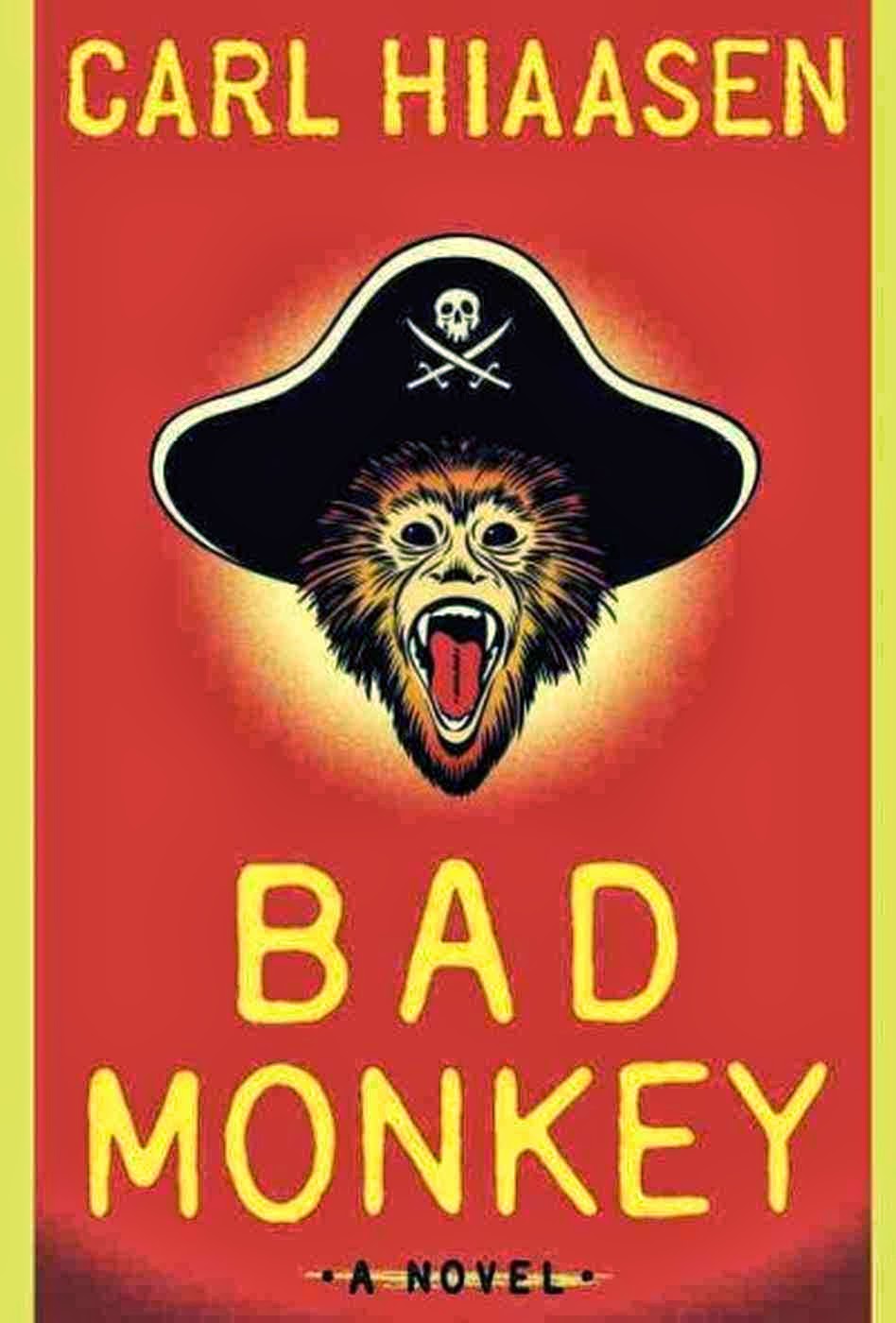
Hiaasen's new novel 'Bad Monkey' is good

WATKINS GLEN, New York - Carl Hiaasen's latest novel, Bad Monkey, isn't really about a bad monkey, although there is one it in. And he is bad. Oh my, he is bad.

Instead, Bad Monkey is a somewhat typical Hiaasen romp through the byzantine and bizarre world of South Florida politics and police. Bad Monkey at first seemed a little, well, too Hiaasen with characters acting so bizarre, you can't believe them. Even if they are supposed to reside in South Florida. Which is a bizarre place.

But there is no putting this book down. Within the first 100 pages most readers will be totally hooked and rooting for the protagonist of the book, a guy has been busted from his police post as a detective to the roach patrol - a restaurant food inspector. By the way, this book won't encourage you to do much restaurant dining in South Florida either.

How the main character got busted from cop to food inspector I really cannot write about here.  My granddaughter sometimes reads these posts. Right Samantha?

But you find out early in the first of the book. It involved a vacuum cleaner. I've said too much already.

Carl Hiaasen hardly needs any promotion from me. But this book is entertaining reading. It might help you bone up on your voodoo skills, too. For more on that, check out Bad Monkey.

Monday, August 26, 2013

A book about a man called Iscariot - as in Judas


WATKINS GLEN, New York, USA - There are challenging biographies and there are challenging biographies.

But Judas Iscariot, the ultimate Christian symbol of betrayal?


Hoo-boy!

In Iscariot, author Tosca Lee creates a fictional account of Judas Iscariot's life and times, leading from childhood to his suicide (by hanging himself). The work, although a novel, is based on years of research by Lee who also authored Demon: A Memoir and Havah: The Story of Eve - both bestsellers.

It's a fast-paced book, full of the kind of historical detail that makes such volumes easy to read. After all, you know how it ends. But getting there in this case is everything.

Tosca Lee
Lee builds a case that Judas was not the penultimate devil that most Christian theologians have made him out to be. If anything, he was more devout than the other apostles. But in a twisting and turning set of events, he ends up with the famous 30 pieces of silver.

It was a mistake and he knew it right away. But the book postulates  it was all way more complicated than that.

Iscariot is actually an uplifting book in many ways. And well worth reading.

It was good enough that I am on the trail of copies of Tosca Lee's two other works.


Wednesday, July 17, 2013

"The Eye of God" James Rollins' latest thriller

MONGOLIA - Normally, covers that indicate a book is part of a series - in this case a Sigma Force Novel - turn me right off.
James Rollins

It might be the same reason I don't eat at franchise restaurants. I want something original, fresh - like a Lionel Shriver or Jodi Picoult novel where the characters are new, the plot lively, and not a rehash of some old plot or formula that resulted in an avalanche of book sales. (James Lee Burke novels are a notable exception to this by the way. His new book Light of the World will be out July 23 and the characters in it are old friends.)

In the case of The Eye of God by James Rollins, I decided to take a look anyway, as it had quantum physics, time travel and religion mixed up in the mash with the Sigma Force people.

It was a formula that worked.

If the book were shorter, I would recommend it for reading during an airline flight across country. But at just over 400 pages, it's longish. And the action is fast and a little too tiring take in to read in just one or two settings.

Like many action books, this has a serious end-of-the-world bent, but just enough plausibility of science, religion and military action to make it, well, believable. The physical feats of some of the characters stretch credulity, but then swimming under ice flows in Lake Baikal never seemed like a good idea to me anyway.

I can't speak for other Rollins' books, but The Eye of God is worth of look. And if you do pick it up, follow it all the way to the very end. There's a surprise ending with a heart warming twist involving time and its relation to the universe. 


Thursday, May 09, 2013

Follow the money in Roger Hobb's 'Ghost Man'

WATKINS GLEN, New York, USA - Ghost Man by Roger Hobbs moves back and forth in time in a way that in many novels can be sooooo irritating, I give up on them.

Hobbs
Ghost Man does so seamlessly.

And that this is his first novel makes that accomplishment - along with his well-developed plot and nearly flawless execution - all the more impressive.

The storyline is pretty-classic crime novel with robberies, crooks, and a lot of hi-tech communications and gadgetry thrown in to complicate matters. And there is plenty of gun play, too.

Interestingly, all of the scenes, robberies and technical details come off with a solid ring of truth.

Roger Hobbs did his homework, it seems.

He gives a glimpse into a crime world that is as dark as it is chilling. Think of The Sopranos, but without much of the humor that was sprinkled in those HBO programs along with  crushed fingers and blood.

There are also references to what happens if a person is forced to ingest a large quantity of nutmeg. But to give away that - and how it fits in to the book - would give away part of the plot.

Danger! Danger! Nutmeg!
I'm not telling. There could be a Ghost Man lurking outside my door right now.

With nutmeg.

Ghost Man is well-worth a close read. And it will be extremely hard to put down.


Tuesday, April 30, 2013

The Graves Are Walking - a book about famine

John Kelly
WATKINS GLEN, New York - The Great Famine in Ireland, the one that sparked the massive migration of Irish from Ireland to the United States and Canada, has been written about extensively since the 1845s when the potato crop went bad and agriculture was decimated.

But a 2012 book by John Kelly, The Graves Are Walking, gives a fresh look (and accurate historical account) of that terrible time, for which most Irish people blame their English overloads of the era.

There is plenty of blame to go in that direction. But after reading Kelly's work, it seems clear that the famine and subsequent events were as much a fault of classic British bumbling as malignant intent.

The book walks through the famine years, explaining the massive exodus from Ireland and why the millions died of starvation. Could many of them have saved had the British acted more in the interests of the Irish? Yes. That they didn't was part ineptitude and a large dose of British attitude about the Irish people.

The Brits believed - perhaps still believe in some cases - that the Irish reliance on the potato as the major farm crop was because the Irish were lazy. Potatoes were simply too easy a crop to grow, Kelly writes, leading the British to have nearly complete a lack of sympathy when the crops failed.


And when I say crops failed, I mean the entire planting of potatoes. Without shipment of food from outside of Ireland, people knew the Irish would starve - which they did because relief measures were pathetically inadequate.

The Graves Are Walking is not easy reading, but it's hard not to hear echoes of some modern American attitudes about the poor in the U.S. eerily reflected in this book.

It might be a good volume to ship to some of our GOP legislators who want to slash food programs for the poor.

It's on the new book shelf at the Watkins Glen library and was published by Henry Holt and Company of New York city.
A starving Irish family in County Galway


Monday, January 28, 2013

'Hitchcock' bio-pic a winner with Anthony Hopkins

HOLLYWOOD, California, USA - Alfred Hitchcock's movies have always fascinated me. And one episode of his popular television series once scared me sooooo badly when I was about 10 years old, I would wake up screaming in the night.

The real Alfred Hitchcock
I forgive him for that episode. But if I wake up tonight in a cold sweat because a creature is coming up my stairs, I'll post something in this space tomorrow. Unless the creature gets me, of course.

The picture stars Anthony Hopkins in the title role with Helen Mirren as Hitchcock's wife, Alma. The rest of cast is dynamite, too. And I challenge any male who watches this film to avoid being smitten by Scarlett Johansson. She plays the role of Janet Leigh who, in turn, played in one of Hitchcock's most famous films, Psycho.

Scarlett Johansson
Psycho is the template around which the entire movie revolves. How Hitchcock and his wife work as a team is fascinating. And the movie script for Psycho gives plenty of insight into who Hitchcock himself was.

A tortured genius is a gross understatement.

Hitchcock is well worth seeing. But unlike his television series, it's unlikely to keep you awake at night. I think.


Sunday, January 20, 2013

Film 'Argo' a winner - great actors, great directing

TEHRAN, Iran - The movie 'Argo,' directed by and starring Ben Affleck is a tour de force of moviemaking.

I am not entirely sure what a tour de force is, but is certainly sounds impressive.

Ben Affleck as a CIA agent
The script and directing are as tight as can be. It's one of those movies you don't want to look away from the screen for even a second - you will miss something. I did, and replay is really hard on a computer.

Lots of CIA intrigue in it. Mostly it shows that our government can get things done, but largely in spite of itself. The top dogs of the government don't come off well. Only the misanthropes, like the character played by Ben Affleck seem to navigate it well.

All the actors did a great job in this film, though John Goodman and Alan Arkin really went over the top in their performances. More of that tour de force stuff.
Arkin and Affleck

The story line is dramatic - U.S. hostages during the Iranian crisis of 1979-80 need to be rescued from the Canadian embassy where they are hiding out.

But beyond that, no spoilers here. Watch Argo instead. It's worth it, especially the final few scenes.
Getting past the Iranian guards

Wednesday, January 09, 2013

"Hope Springs" - a painfully funny film

NUEVO VALLARTA, Nayarit, Mexico - Last night I watched Hope Springs, a film billed as a romantic comedy with a great cast: Tommy Lee Jones, Meryl Streep and Steve Carrell.

With those three, how can you miss? Really.

Steve Carrell
Still, I am not much of a romantic-comedy fan. Seen too many Jennifer Aniston and Sarah Jessica Parker films bomb.

But Hope Springs is funny, in a painful sort of way, depending on how many years you have been married and what you think about couples counseling. I would say it's a dark comedy.

And worth watching.

Elizabeth Shue
Tommy Lee Jones stole the show with his acting, though Meryl Streep's portrayal of his wife was Oscar-caliber, too. And Steve Carrell? Carrell played it sooooo straight and in doing so, was far funnier than in any schtick he could have come up with.

I would recommend the movie without reservation but with one caution - watch it very carefully.

This is not a movie that allows you to work in the kitchen and just listen. If you don't watch for all the visual cues, you miss a lot. The facial expressions alone are amazing.

Also starring in Hope Springs in a cameo roll as a bartender is Elizabeth Shue. She's steals her scenes without effort.

Tommy Lee Jones and Meryl Street

Tuesday, December 04, 2012

"The Trial of Fallen Angels" takes you - somewhere

NUEVO VALLARTA, Nayarit, Mexico - The Trial of Fallen Angels by James Kimmel Jr. is a remarkable book from two directions. First, it is well-written and easy to read. Second, it is his first novel.

Kimmel
I have wailed in this space about first novels before - usually that they don't have the snap that later work does for most novelists. But Trial reads as quickly as a detective novel, though the plot will weigh heavy in most reader's hearts.

I mean really heavy.

The book is about dead people. Well, no, wait. Dead people isn't the right way to say it. Perhaps souls in transit would be better.

These souls are headed towards heaven, or somewhere else, and all are caught up in an ecclesiastical judicial system. No, there aren't practicing lawyers in heaven (we can hope). But then this book doesn't take place in heaven.

Trial is set in an otherworldly locale where things, as you might guess, are never exactly what they seem. And people's motives, sins, and intentions are never as simple as we still on earth would like them to be.

The Trial of Fallen Angels has plenty of twists and turns, too, making it close to a page turner.

Just don't read it right before you go sleep. The dreams I had for several nights running were pretty spooky.

No, make that really spooky.


Tuesday, November 20, 2012

Isaac Asimov's "Nemesis" warns of Earth's future

NUEVO VALLARTA, Nayarit, Mexico - The late Isaac Asimov's classic science fiction thriller Nemesis is both uplifting and sad at the same time.

Isaac Asimov

The 1989 tome came out as most of the U.S. population had given up completely on space travel as something worth pursuing (and funding). That's the sad part. When the U.S. first went to the moon, the plans were for a manned-mission to Mars by 1985.

That never lifted off the ground.

But the uplifting part is about human nature and how in the end, humanity saves itself from cosmic disaster through clever thinking (with a little help from an alien intelligence). A relative handful of humans leave Earth in the book, trying to find a new world for everyone. That's all the plot you get from me.

I just finished reading Nemesis for the first time and like all good science fiction it holds the test of time.

Perhaps oddly, it talks about the need to save the people of Earth who are living on a planet stripped of natural resources and polluted beyond belief. Sound familiar? The Earth's population at the time of Asimov's Nemesis? About 8 billion. That's 1 billion more than live on Earth as I write this. And Earth's population went from 6 billion to 7 billion in just over 11 years.

Are we stripping the planet of natural resources and polluting it beyond belief.

Yup.

If you are a science fiction buff, grab a copy at a used book store or get it through Kindle or the iBooks. No warp drives pushing space ships around in this book - they have better, more interesting stuff, though.

Saturday, November 03, 2012

Climate change connects with the Zoo

WATKINS GLEN, New York, USA - The hammering that New York, New Jersey and other eastern seaboard states just took from Hurricane Sandy might - might - be a wakeup for people about the reality of climate change.

My relatives in the Long Island-New Jersey area are all ok, but it was (and remains) a harrowing experience that will be talked about for years. As of this writing, most are without electricity and heat and repair efforts are slow at best, more likely glacial.

As Hurricane Sandy roared through the Finger Lakes - and it did roar through but doing relatively little damage - I was finishing a book called Zoo, James Patterson's (and Michael Ledwidge's) latest.

I have not been much of a Patterson fan in recent years, but this book should get more attention from people who are watching climate change, genetically modified food effects, and the destruction of the planet as we plunder it for oil, gas and minerals.

It's hard not to spoil the plot here. But I will say that the book describes how man's incessant desire for more industrial growth leads to a problem with animals. No, they don't get sick, exactly. But imagine your pet Chihuahua suddenly turning from a yipping little thing with a grapefruit I.Q. to a clever, conniving pooch with the attitude of the late Leona Helmsley.

Ouch. That really bites.

I had a biology teacher in high school who used to say that "Mother Nature always bats last."

Hurricane Sandy was a good demonstration of that. And Mother Nature still is at the plate.

A reading of Zoo is just as frightening.